Thursday, September 21, 2023

A path divided

“Two roads diverged in a yellow wood . . .” Frost’s The Road Not Taken was a grade school standard when I was a child, and I’m surprised that I can’t recite it by memory. (As ever, when I notice my memory fail, I reach for paper & pen in order to draw a circle, make it into a clock adding numbers and setting the hands to ten past eleven, two to two. Still ok. So not a sign of memory loss then, just a sign of aging.) 

For years when Doug and I walked together, I led, if only because I had the longer legs and the faster pace. Turning to make sure he was behind me became second nature, until it became clear that I couldn’t be sure he would follow me, and we started to walk everywhere hand in hand. 


Long after Doug moved in to long-term care and I walked by myself, I’d stop and look over my shoulder. Even though I knew he wouldn’t be there. I thought this would be a habit for life. That I would never stop pausing, looking over my shoulder, making sure he was there. 


But Dementia created a fork in the road, and neither of us can truly follow the other. I thought about this a lot over Labour Day weekend, which was glorious - warm and sunny. I sat on my deck with a coffee first thing in the morning, before joining my family for a local walk we all love. Doug loved it too, and we often walked it together when he was still able to. 


After that walk I visited him in his home, where he was on isolation due to a respiratory illness (he has since recovered!) so I wasn’t able to take him outside in his wheelchair to feel the sun on his face. I was in full PPE, unrecognisable even to myself. I looked at him in his bed, knowing he was unaware of the gorgeous weather, and I tried to pretend for a few moments the fresh Ontario peaches and local raspberries I’d brought him were a treat that in some small way made up for his quarantine, and the fact that he hadn’t joined me for coffee on our deck, or for a walk with the family.


In the beginning he lost his words. Now I’ve lost mine. I read other people’s words to him whilst holding his hand. If I can make it through a visit without crying, I consider that a win.


I am currently reading him non-fiction (half-memoir, half-history), a book about the American Civil War which we both enjoyed reading together in the past. It was only published in 1988, but I am surprised by the language. There are words I won’t read aloud, so I change them or skip those sentences . . . which is making me think about censorship, change, freedom of speech, banned books, my past offences . . . all subjects I’d love to discuss with Doug. (One podcast I listen to calls them “deep dive conversations.”)


What I want to tell him is this:


After over six years’ deep friendship with a woman I first met via the Breakfast Club (a woman Doug knew well), I recently met her son. It is, in retrospect, extraordinary that our paths hadn’t crossed before, as I’ve met her daughter, son-in-law, sisters, nieces, grandchildren, great niece and great nephew, brother-in-law . . . Doug and her husband were very close friends.  Her son has a busy life (job, pets, friends) and for the past many years he was his wife’s primary caregiver. And then there was Covid. Last year he was widowed; this year we met when his Mom suggested we might be compatible travel companions. 


We are indeed compatible.


A door has opened unexpectedly. I have walked through it, and embraced this new relationship. If our roles were reversed, and Doug had lost me to dementia, so that I was no longer able to go to the movies with him, have dinner with him, travel with him, I hope he would do the same, and allow his heart to expand. I am choosing to continue living my life; my new companion is not replacing Doug, and he understands - with first hand experience - what it is to lose someone to an illness, what it is to say goodbye again and again, what it is to grieve the loss of someone who is still alive. He knows that Doug is my husband, and still very much a part of my life, and we are navigating the circustances of our relationship with care and love for all.


“Decisions and events. Some we control.  Others we don’t. But we do what we have to do to survive and create lives around what we have.” (Karen Dunn Skinner)


Monday, August 28, 2023

Too Late

As my great decluttering effort continues I am still finding scraps of paper with notes from Doug - often something as ordinary as a shopping list, sometimes a deeply personal note to himself. His handwriting in and of itself is a message from the past, the words add another layer of meaning. 

a love note

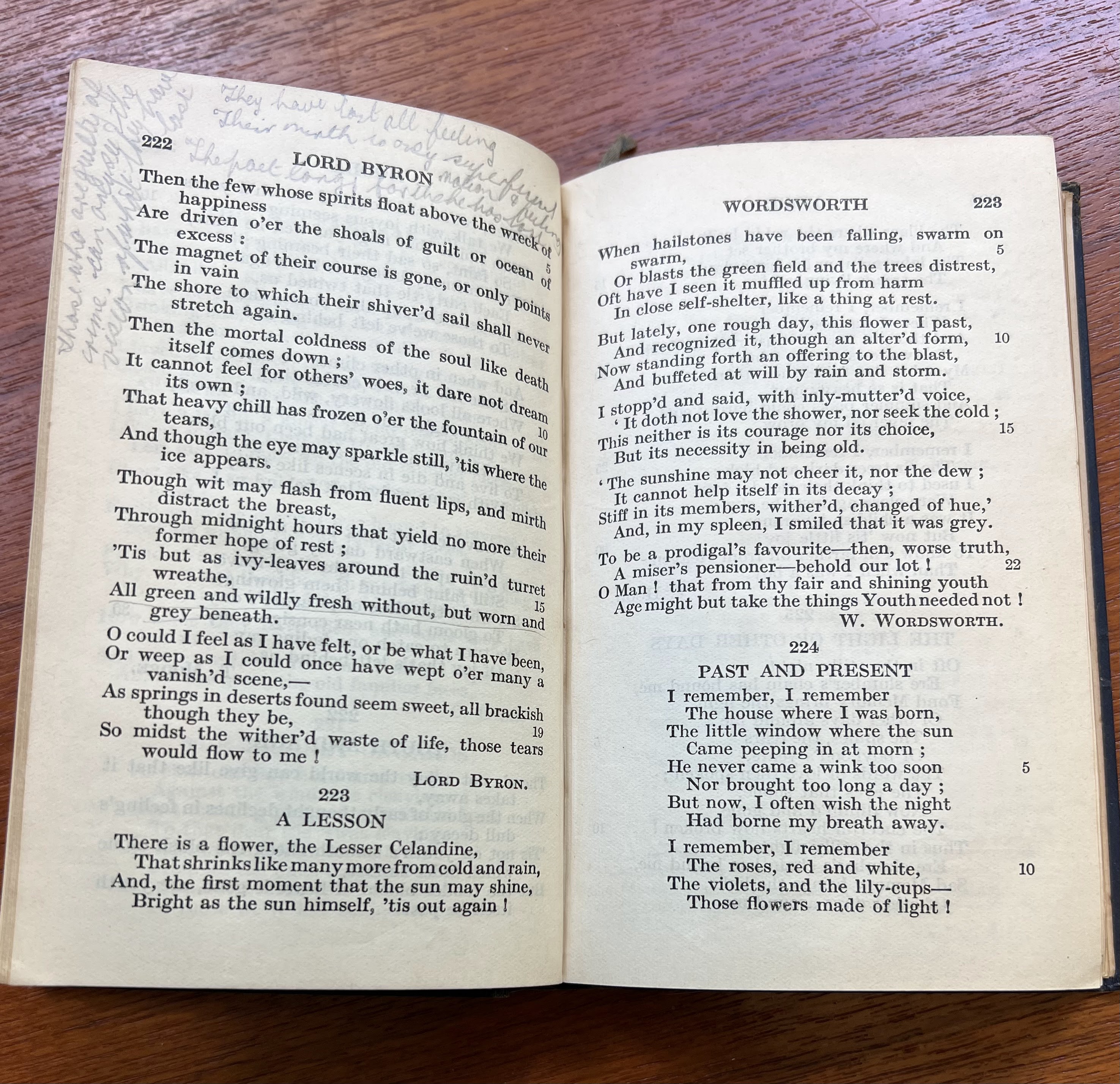
When I was a child, mum read me poetry at bedtime, often from the anthology of her childhood, Other Men’s Flowers. (“I remember, I remember/ The house where I was born,/ The little window where the sun/ Came peeping in at morn (Hood)”) and dad told me stories about his childhood, growing up on a dairy farm during the Depression. (“When I was a little boy in Nova Scotia . . .”) 


 looking up the second verse of that poem led me down a delightful rabbit hole 


I don’t remember being read fairy tales, but I must have been (I do remember being so impatient to read them to myself that I rushed through some words. For several years all my princesses lived in “places” - which made sense - doesn’t everyone live in some place or another? I distinctly remember the day my grade one teacher, Mrs. Sears, asked me to slow down, and I discovered that Cinderella was attending a ball held not in a place, but in a palace . . .)


I believed in fairy tales. 


For years I have held tight to that fantasy despite all evidence to the contrary. Unicorns, rainbows, good luck, hard work, a positive attitude, a stiff upper lip, a glass half-full . . . My fiction rarely ends with a classic HEA (happily ever after), but there is often hope, or the possibility of hope.


the ending of 'Moon Jellies' (from my short story collection, Notes Towards Recovery)


Doug and I had a fairy tale wedding. I would like to say our marriage was also a fairy tale - but that would be a lie. We were (we are) both human. Imperfect. Fallible. Though with the clarity of hindsight I see myself as the most flawed.


There were days I came home from work to discover the breakfast dishes still sitting in the sink where we’d left them hours before. There were occasions he didn’t meet me somewhere at an agreed time, or ever. Frequently I assumed he’d done nothing all day. It’s too late for me to apologise to Doug for being short tempered back then, when neither of us knew what he was dealing with.


I wish . . .


I wish . . .


I wish I’d known he was already struggling with memory issues. I wish we’d talked about it.


I wish I’d understood then how unimportant things like clean dishes were. I wish I’d not been disappointed by what I assumed was his lack of energy. 


I wish . . . I wish . . . 


Too late. Too late now to wish I’d reacted differently.


A short note recently rose to the surface of a pile. It's not one I wish to share. I must have said something unkind about his memory; he must have been heartbroken by my callous disregard for his feelings. 


 in a sad, sad note, covered with happier memories of our Two Together railcard & tickets from adventures we shared in 2015 & 2017


This is one thing I’m glad to know he’s forgotten.


I’m ashamed to admit I don’t remember that day, that moment, what I was thinking, why I lost my temper, why I didn’t keep silent, why I didn’t separate the illness from the person I loved. 


That I broke Doug’s heart then breaks mine now. 


I wish I had apologised immediately after I spoke. 


I hope apologised immediately after he wrote the note. 


I hope I asked his forgiveness. I hope he forgave me. 


I don’t remember.


(And now it's too late.)


Saturday, August 5, 2023

On this day in history . . .

August 4th, 2012

Eleven years ago Doug was full of energy, exceptionally happy . . . and so was I. 


This photograph is full of stories about our wedding day: the beer keg was sent with the wrong spout, so moments before the Beer Store closed my sister & David loaded up the car with bottles; the wildflowers were gathered by Mum & my niece; Mum, Tom, and I picked the berries for and made the jam; my brother-in-law (pictured) was living with a brain tumour at the time and passed away three months and two days later. 

I see all those memories- but most of all I see Doug. Happy, energetic, wonderful Doug. 

We loved our wedding.

"love is more thicker than forget" - e. e. cummings


Monday, July 24, 2023

Closed Doors (Things I Cannot Know)

There are questions I wish I’d asked my grandparents while they were still alive. There are questions I wish I’d asked Dad. I have recently been on holiday with my mother; I tried to ask her all the questions . . . but I know in twenty years I’ll realise there were some (many) I’ve forgotten.

So much I didn’t ask, don’t know, and will now will never know. (I am not the only person to feel this way. How many times does Munro explore this very subject in her fiction?!) 


Doug and I had many conversations when we understood his memory was fading, but there are many serious things we didn’t discuss. I know if he predeceases me he’d like me to have his body cremated in the most environmentally friendly way possible, and then he’d like me to sprinkle his ashes along some of our favourite canoe routes and walking paths. This I can, and shall do. 


I know he hoped that I would never place him into a long term care home. I did not honour this wish. It was one of the most difficult decisions I’ve ever had to make, and I still struggle with regrets, despite knowing that I was no longer able to provide the best possible care for him, despite the horrors of Covid, despite the reality of his health today. Two of his sisters cut all ties with me because of that decision, and Doug lost the window of time they might have spent with him.


As impossible as it seems now, we did not fully grasp how dementia might affect him . . . until it was too late. In some ways, certainly, it was a blessing that we were so ignorant of the future. And yet, knowing that one day we might not be able to have any sort of meaningful conversation would have been helpful back when we could still talk to each other. Back when I could still ask “what would you prefer if . . . ?” and “what if . . .?” and “but what if . . .?” 


I am deeply grateful that I do not have the right as his wife (and power of attorney) to even contemplate MAiD. It is not a decision I could make on his behalf. I will struggle if ever I have to make a choice around euthanasia with regards our cat, Piper. Although I will never want her to suffer, I’ll no more be able to ask her if she’s in pain or not, content or not, than I am able to ask Doug.


One of the many things we did not talk about was what to do if we lost each other in a way other than death. We vowed to “travel together as husband and wife through stormy days and still, for better or for worse, for richer or for poorer, in sickness and in health, all the days of our lives until death do us part.” It is not death which has separated us, but dementia. Even when I am sitting right beside him, I am lost to Doug, and he is lost to me. 


I will always love Doug. I desperately miss the man I fell in love with, married, and made such a happy life with. He is no longer that man, but he is still my husband, and I love the person he has become, albeit in a very different way than I loved the man he was when he was well.


But now, more than ever, I wish we’d talked about a future we couldn’t imagine. 


I am hanging on to his insistence that I “follow my bliss” when we first met and I told him I was thinking of returning to school. It was advice he often repeated, to me, to himself, to others. “I say, follow your bliss and don't be afraid, and doors will open where you didn't know they were going to be. (Jospeh Campbell)”


(I took all these photographs in Tuscany, Italy in June, while I was on vacation with my Mum. It was a holiday Doug would have loved.)

Monday, July 17, 2023

1,204 days later

On March 11th, 2020, Doug and I shared a treat together at his care home. I don't have a photograph to jog my memory, and have no recollection if we opted for hot chocolate and cookies, or root beer and bag of potato chips. We shared treats all the time. I often ate meals with him. I kissed him on his cheek every time I arrived to visit, every time I left, and many times in-between. 

And then - Covid. 

Wednesday June 28th, 2023 the masks rule for long term care homes was lifted and Doug's home opted to allow staff and visitors to choose to wear, or choose not to wear, the face masks which have been part of our lives for so long. When I arrived and confirmed that I could indeed go without a mask, I didn't hesitate; I tore it off.

It was a wonderful experience to walk through the halls and smile at the staff - and receive full smiles in return. I always smile at the residents, but for the past three years plus they've only been able to detect the smile in my eyes. 

Reaching Doug, I knelt down and kissed his cheek.

After the hurricane I promised myself I would never again take for granted the joy of turning on a tap to fill a glass with drinking water. I am promising myself now that I will never again miss the opportunity to smile at people - loved ones and strangers - or to kiss someone I love. 

2014: our annual 50-miles-in-a-single-day walk
Maybe this was preparation, unbeknownst to me at the time, for the long haul of Covid-within-Dementia


Thursday, March 23, 2023

Holding On & Holding Hands

For as long as possible I held on to the hope that somewhere deep inside some part of Doug recognised something about me. The sound of my voice, the feel of my hand in his, my scent - something, anything. And then I held on still longer. 

No one who knows me was the least bit surprised: I struggle at letting go. I cling to things long after their useful lifespan. Relationships which aren’t beneficial to either party, bits of paper (theatre and train tickets) I may scrapbook (‘one day’), more books than I’ll ever read in my lifetime, mementos which continue to collect dust after they’ve ceased to spark joy. 

There are two bookcases, every shelf double-stacked, with Doug’s collection of non-fiction. Sometime in the future, when I can no longer stack my books against the sides of our other bookshelves, or when Piper knocks them down yet again, I will box up his through tears, and deliver them to a place where they can be discovered and enjoyed - maybe even read - by someone else. 

I am better at giving away his clothes to people who need them. Better, but his kilts, a suit we bought for a super special dinner, his Maple Leafs hockey sweater, a few of his favourite ties, and a few other items are still hanging in our bedroom closet. His last pair of walking boots and his poles are tucked into the front hall closet. His golf clubs and guitars are taking up space. 


When Mum and I cleared out Aunt Em’s flat we shared memories about the objects we were packing and donating until we ran out of time. It was lucky, we agreed, that anything we wanted to keep had to be shipped to Canada. (Though I do regret being quite so harsh in my refusal to bring back much at all, I have photographs to remind me of the happy memories the objects sparked.) We left her wardrobe for last, so that we had to rush through everything that still held the suggestion of her fragrance. 


But Doug hasn’t died. And nothing in our house smells like him. (And, in reality, he no longer smells like him. Not the Doug I knew and loved when we lived together. That’s gone, along with his voice, his mobility, his recognition of me.) 


‘Whose needs are you meeting by visiting your husband?’ My therapist asks me. 


Today I can speak the truth she has known for much longer than I have. Mine. My needs. 


He doesn’t know me. There is nothing about me that differentiates me from any of the other people who care for him. Even when I read him one of our scrapbooks, recounting our past adventures. Even when I sneak us away to an empty room and take off my mask to show him my face in one of the rare moments his eyes are open. Even in his heart of hearts. (And yes, this is also a blessing. I am confident his intelligent, active mind is not trapped inside his deteriorating body. That would break me.)


But I know him. I recognise him. I need to sit beside him, to feed him some of his meals, to hold his hand, to read to him, to hug him, to kiss his forehead. I don’t know how else to express my love for this man. The person he was, the person he is now. 


The other day he was napping, and, whispering a memory of another time we’d tried to share a single bed, I squished myself next to him. His hand had been raised above his head and it fell over my shoulder. As close to a hug as I could imagine. 


I am holding on to that moment.


2018: happier times, when we were able to hug each other

Monday, December 5, 2022

Remembering

“At the going down of the sun and in the morning/ We will remember them.”

October sunrise

I often open my classes by reading, or asking a student to read, a poem (or several poems). The week of Remembrance Day we read some of the classics: Binyon’s For the Fallen, Magee’s High Flight, Gould’s This Was My Brother, and spoke of others. We also read the poetry of other wars, other losses, including two poems from Dikra Rider’s chapbook, There are no Americans in Baghdad’s Bird Market. 


We spoke too of 9-11. Ancient history to a few of my students, pre-history to most. (Yes, yes, I was momentarily startled, as I always am when I realise that my having vivid lived experience of that day makes me decidedly old.) And I looked at these bright young people and wondered - when they are my age, how will they remember the pandemic of 2020-22?


It will be interesting to compare the literature of 2022 with that of 2042. In twenty years’ what will a pandemic background look like? What will we have learned? (Note my strength-based optimism! Partially bravado . . . because I am not entirely sure we have learned anything yet.)


Kerry Clare recently wrote about Emily Urquhart’s essays which are set “against the backdrop of the Covid-19 Pandemic.” 


And my work in progress is very much set during the time of Covid. It can’t not be. The social isolation and the choices my characters have to make are all vital to the causal unfolding of events. (I hope this is a novel. It’s supposed to be a novel. But some days I write pages which are clearly just me trying to make sense of things and have no place in the work itself.) 


My Mum, sister, and I recently, quietly, marked the anniversary of Dad’s death.


“At the going down of the sun and in the morning/ We will remember them.”


On September 30th I wore orange in memory of those who survived, and those who did not survive, the residential school system.


“At the going down of the sun and in the morning/ We will remember them.”


Tomorrow, December 6th, The National Day of Remembrance and Action on Violence against Women, I’ll light candles in memory of 14 women who were murdered in Montreal in 1989. 


“At the going down of the sun and in the morning/ We will remember them.”


Victoria, BC, 2018

I am currently reading Doug Above the Fold, John Hondrich’s memoir. Doug’s years at the Toronto Star comprised almost quarter of a century. (He and his Dad wrote & edited that paper for over half a century.) It was the most important part of his life, for much of his life, and a time when I didn’t know him at all. I was sure I’d find mention of him, his dad, and all his friends and colleagues I’ve met. When I read an anecdote and know (or think I know!) the names of those not mentioned, I am adding them in the margins. (Ha! I hope Hondrich might see the humour in my editing his prose.)


There is a link here - but I’m aware I’m asking you, dear reader, to fill in some blanks*. Memories. Witnessing. Loss. 


November sunset

*But there you go, I am setting you up for success next time you read a short story, as you’ll approach it with the understanding that the author requires you to do some of the work! 


“They shall grow not old, as we that are left grow old:

Age shall not weary them, nor the years condemn.

At the going down of the sun and in the morning

We will remember them.”