Sunday, May 30, 2021

Various Miracles

I am so deeply grateful for the rapid Covid screening test, which allows me to be swabbed at Doug’s care home, confirms that I am still negative, allows me to visit him daily.

The weather has been gorgeous and I was able to take Doug outside, into the fresh air and sunshine (until the home went into Outbreak. Because . . . what . . . the Covid pandemic wasn’t enough?!).


These past weeks I have watched poplar leaves and crab apple blossoms unfurl, maple buds transform into leaves, hillsides turn from grey to blue to green, ducklings and goslings grow by the day. 


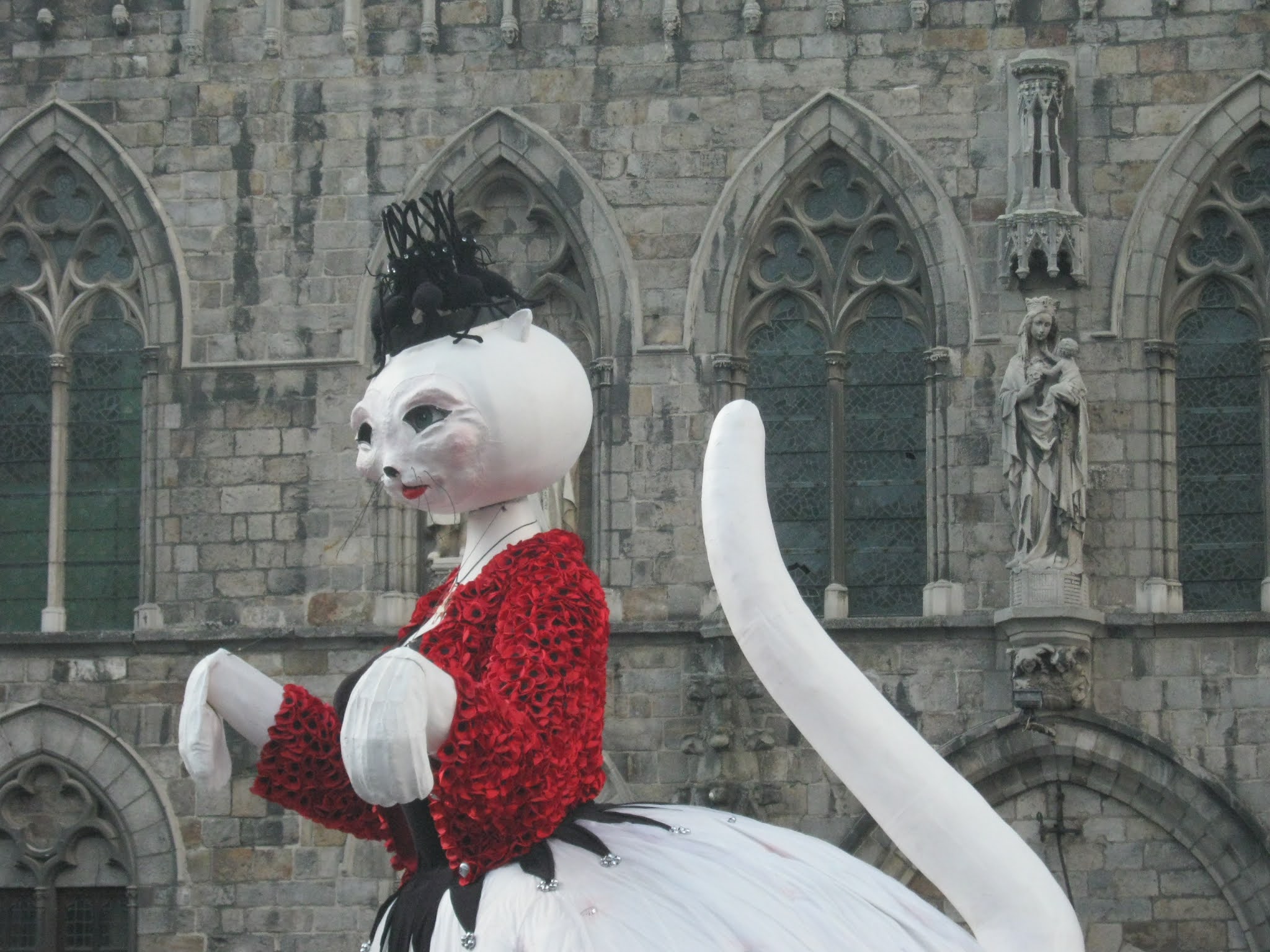
Mid-May I celebrated my birthday; in 2012 I celebrated with Doug, in Ypres, at the Cat Festival.  We rented bikes to cycle to battlefields and cemeteries, and as he was filling in the rental form he turned to ask me what the date was. ‘It’s my Birthday!’ I reminded him. It wasn’t supposed to be a trick, or a test - but, alas, it was. ‘My Birthday’ wasn’t any help to him, he had no idea what date my birthday was. 

There were other signs of his memory challenges prior to our noticing and worrying enough to go to the doctor: he forgot to come to a reading & talk I was giving with Dame Gillian Beer at Clare College, Cambridge University (one of the highlights of my time as a Phd student), then was worried and angry when I got home as he’d had no idea where I was. He was late for many meetings. He grew increasingly confused about where we lived, and which fork in the path to take on a same-every-single-day route.


I would like to forgive myself for the times I was irritated that he was (apparently) so scatty and disorganised, or the evenings I arrived home from work and found breakfast dishes still stacked by the sink, or the days when he appeared to have accomplished absolutely nothing, or the first time he wasn’t able to navigate with map and compass.  Also, I would like him to be able to forgive me for the times I argued that he needed to shave, and worried at his seemingly obsession with packing and re-packing, and wished out loud for a cup of tea he was no longer able to prepare. 


There is so much I wish I’d known when we started; there is so much I have learned. 


Name tags work.  (Even after he was no longer able to read my name, staff and some residents at his care home didn’t have to wonder who I was.)


Poetry works. (For us, poetry he knew and loved when he was well, some of which he continued to recognise, at least in part, for a long time. Rhyme works. Shakespeare works.)


Music works. 


Love works. I can’t love him well again, but I can love seeing the sunshine on his face, love knowing that he is well cared for, love holding his hand, love the sound - still, occasionally - of his laughter. 


I am deeply grateful for fiction, which both transports me and grounds me, and for my friends, who do the same. Miracles indeed. 


(The title of this blog post is that of a Carol Shields story.)


Sunday, May 2, 2021

Past Imperfect

I miss my husband. I miss our conversations, and all the things we did together: our walks, our adventures, our shared loves, the things we discovered together. I miss reading & discussing books, watching & talking about plays, cooking together, taking random courses together in order to learn how to make cheese, build a pizza oven, or more effectively use a compass. I even miss our differences. I just miss him, and us. 


The end of the Pathfinder walk, a 46 miles-in-a-day-walk (50 by the time we walked to and from our B & B). Exhausted, but smiling, and ready for a pint. 

Just to be clear, my husband is still alive. 


And he’s still my husband. And I speak of him in the present tense: Doug loves pie. Doug loves music. Doug has a great sense of humour.


The end of our Hadrian's Wall Walk, which we added to in order to make it a true coast-to-coast. 


It breaks my heart when people refer to him in the past, though I understand why they do. He is not the person we used to know. And past imperfect is the correct choice, alas, for many of his loves and hobbies. He used to play the banjo and bagpipes. He used to be a voracious reader. He used to be a talented writer and editor, and he used to have a beautiful singing voice. He used to bake all our bread, and make jam, and preserve pickles, and . . . and I’ll stop before I just list all the things he is no longer able to do, because that will only lead to sadness.


The transition I made from wife to wife-caregiver was difficult for both of us, and the transition from wife-caregiver to caregiver even more so. This new transition I’m making (slowly, reluctantly, as if I have any voice in the matter at all) from caregiver to stranger is difficult only for me; he is unaware. That gives me some comfort. 


He sometimes looks at me, smiles, and says “hello!” as if he’s pleased to see me. Just as often he looks at one of his professional caregivers, or a housekeeper, or another resident, smiles, and says “hello!” in the same way. I’m truly glad he’s so pleased to see so many people. We’re both introverts, but he used to be the social one - great at telling jokes, and making small talk, and listening, and mixing drinks, and hosting gatherings. We used to be a great team. 


I am super lucky - truly blessed - to have friends I can ring in tears. After a recent incident at the long term care home, I called a best friend who listened to me, comforted me, and then reflected that Doug is not the man I once knew. Sometimes I need to be reminded that his reality and mine are different. And that it is OK for me to grieve the loss of the man I used to know. 


I used to love him;  I love him still.


Friday, April 23, 2021

“Hope is the thing with feathers . . .”

I have many super powers: finding silver linings, re-framing, focussing on the positive . . . But there are days when hope is more elusive. Days when Covid numbers are climbing and harsher measures must be enacted, days when the top stories are all bad news, days when I learn a dear friend who has been living with a sore back for months is, in fact, living with incurable bone cancer, days when Doug is grumpy or sad . . . days when I am grumpy or sad. 

There are books. (There are always books.) And there is chocolate or pasta or pink grapefruit or blue cheese or whatever my favourite food of that second happens to be. There is poetry. There is music. There is nature. There is walking.

And always, always there are friends, and my sister and my Mum, and Piper-the-Cat.  


And there are words, when I am able to find them. 


Doug was never a competitive Scrabble player; his vocabulary is (used to be) extensive and he delighted in playing the most interposing words, not those with the highest score.  


We played against each other, and then, as his words disappeared he and I played as a team, against my sister and her youngest daughter. At that time my niece could spell “cat” and “joy” - in one of those games Doug played “loyalty” and then “talisman.” My sister and I ignored our teammates’ occasional misspellings, and awarded points for effort and enjoyment.  I watched over the months as my niece’s spelling improved, and Doug’s worsened.


When he first moved into his care home, Mum and I played Scrabble, with Doug drawing tiles from the bag, sometimes managing to count the correct number, sometimes not. No one cared. And then Covid: so it’s been over a year since my Mum has visited her son-in-law, my sister her brother-in-law, my youngest niece her favourite Uncle. 


I still take our bag of tiles to his care home. Years of use have worn the wooden corners, and they are lovely and smooth. I spell out DOUG and LOVE and make sure he doesn’t put the tiles into his mouth. So there are always words - even when I struggle to find them. 


This week I am holding Melodie & Donna & Lorie especially close in my heart. 


Onwards, with love. 


“Hope” is the thing with feathers


-Emily Dickinson


“Hope” is the thing with feathers -

That perches in the soul -

And sings the tune without the words -

And never stops - at all -


And sweetest - in the Gale - is heard -

And sore must be the storm -

That could abash the little Bird

That kept so many warm -


I’ve heard it in the chillest land -

And on the strangest Sea -

Yet - never - in Extremity,

It asked a crumb - of me.

Thursday, March 25, 2021

The Ferret-Jello Hypothesis

Doug and I met online, and spent several weeks writing emails back and forth before we spoke on the phone. My first impression of him was firmly anchored in his his love of words, and his love of writing. Two (of the many!) things we shared in common. 


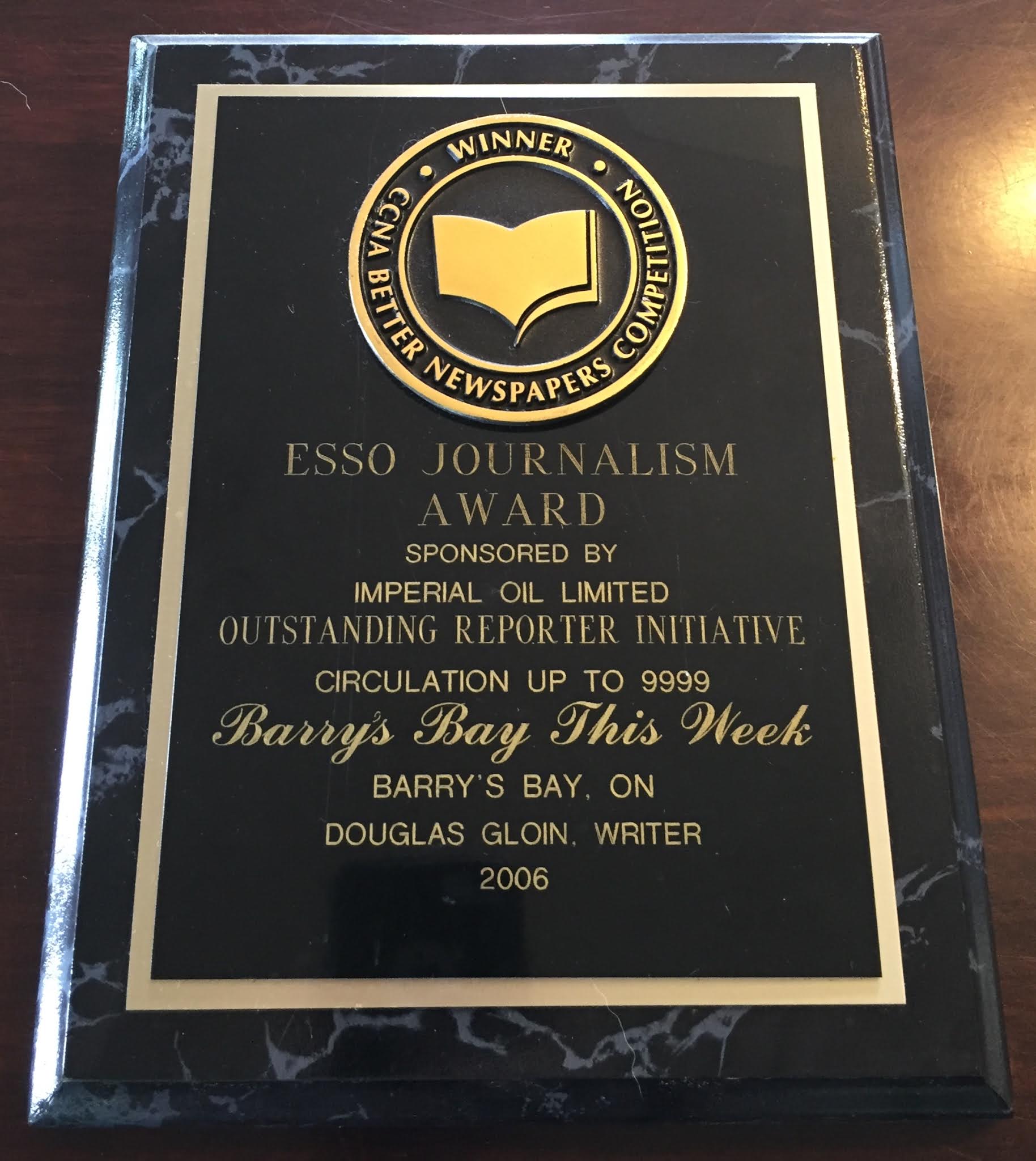
An award Doug won for a Remembrance Day special feature he researched & wrote

At that time, Doug was running the newspaper in a small town, having retired after almost quarter of century working for the Toronto Star. He was a voracious reader, an excellent writer, and had a phenomenal vocabulary. His Dad, also an Star man, wrote a column about words, and reviewed books, amongst his other positions. Doug spoke of how their house overflowed with advance copies, review copies, books and more books; one of my childhood friends thought I lived in the library . . . and our homes (in the UK and now here) are similarly over-booked. (And yes, every single book in this house ‘sparks joy’ in my life.) 


Books & words & books about words . . . three from our bookshelf


Pre-Covid I had the best summer job - teaching Creative Writing to a group of International students in Cambridge. I loved introducing my students to OuLiPo, the poetics of chance, and Mitch Goldstein’s ‘Ferret-Jello Hypothesis’ (which suggests that we will always try to forge a relationship between two nouns which are linked only through physical proximity to each other, in order to make sense of what we’re hearing or reading) and then playing with writing exercises purported to have been created by a group of Surrealists.


The summer I was 10, Dad and I visited some of the most beautiful countryside in Canada. All I wanted to do was read. 


Fun fact: On my Dad’s side of the family, I am distantly related to dictionary writer, Noah Webster. On my Mum’s side of the family, I am less distantly related to dictionary writer, Felix Author Yockney. I grew up in a house where dictionaries were kept in the kitchen (and several other rooms as well), and were consulted multiple times a day, and every room (including the bathroom) had bookshelves. (I'm so lucky to have been brought up in a house where it was so easy to fall in love with reading.)


My heart has broken a million times as I’ve watched Doug lose the ability to read, and lose his nouns, and lose his sentence structure, and lose much of his English. Never blessed with a child to raise, I wonder if his loss of language is a reverse mirroring of the way he learned it. I think about a Linguistics course I audited during my undergrad, and non-verbal communication, and how easy it is, in fact, to carry on both nonsensical conversations and entirely one-sided conversations. And I am very aware that when Doug strings seemingly random words together, I am desperately trying to find a connection, to make them make sense, to listen and to hear and to understand. 


(If you didn't know, you might think Doug is reading his mail)


What he has not lost is his gorgeous singing voice (the words don’t matter), and his ability to whistle, and his laughter.  Also, he has not lost his love of listening to poetry, and making rhyming words, and the sound of music. 


Words still matter. Words still connect us. 


Sunday, March 7, 2021

The Gift of Stories

I tend to economise at the grocery store, because I find that an easy way to save money for other things more important to me. I’m a person who shops the reduced table, buys day-old, chooses a bag of legumes for protein. There are exceptions: if I’m cooking for other people, I buy the best I can afford. If I’m in a fabulous deli in another city, all bets are off. And if an avocado or a mango looks perfect, I’ll often splurge. This week I treated myself to a bag of blood oranges. 


I was three and three quarters when I ate my first blood orange. Italy, 1971. I argued with my older sister; this couldn’t be an orange, because it was red. She pointed out that it was the name of the fruit, not the name of the colour of the fruit. I didn’t call a banana a yellow, or an apple a green. Or maybe she didn’t. I wasn’t yet four - I don’t really remember the exact details of the argument, just that there was shouting, and crying. And in all likelihood my sister didn’t care that I didn’t recognise an orange, albeit a red one: our eldest sister had just died. We’d been bundled up, we’d been driven through a blizzard to Montreal airport, we’d flown to Italy, and been met by my Mum’s sister, my Aunt Em. This wasn’t a holiday; it was an attempt to escape an unbearable grief. 


I have explored that story in poetry, and in fiction. It’s one of very few early childhood memories I have. I am aware I grant it more poetic weight than it truly deserves - but isn’t that the way of the stories we tell ourselves about ourselves? Fifty years later, blood oranges are still magical to me, still a treat, still transport me back to that long ago moment. 


A friend of ours recently sent some photographs and snapshots of Doug’s early adulthood, with stories about the moments captured on film. (Thank you, Ron!) What a gift - to have a window into the past of the man I love, to hear his stories, many of which he’s never told me. 


Every story confirms that Doug has always been Doug. A good man, an everyday hero, an optimist. He once rescued a woman from a car accident; once she was safe, he laughed at the song she’d been forced to listen to on repeat. 


At a party held in a converted barn, he mixed himself a strong cocktail and drank it from a pineapple. At some point during the evening he opened the wrong door and fell backwards down a flight of stairs. Instant panic - he could have broken his back, or worse, his neck. But as everyone rushed to the top of the stairs, Doug grinned and held up his pineapple. “I only lost half my drink!”


A glass half-full. That was Doug, and that is Doug. (Also drinking from a pineapple, and falling down a flight of stairs - that’s so Doug too.) 


This week marked an anniversary of sorts for me. On March 5th 2005, I was (according to the paramedic who saved my life) 7 minutes away from death. Since then, I have left a bad marriage, moved back to Canada (and back to England and back to Canada again), met my youngest niece, grown to truly know my other niece and my nephew, gone back to school, earned an MA and a PhD, become a teacher, become a writer, spent time with my family and friends, made new friends, had my first book published, met + married + made a life with Doug.


How many stories would I have lost had I not survived that day . . . 


It is heart-breaking that Doug no longer holds the favourite stories of his life - but they are not lost. We who have witnessed this wonderful man now carry his memories for him. 


Europe, 1989

Friday, February 26, 2021

The (First) Worst Day (How I Learned About Exit-Seeking Behaviour)

In September 2018 I attended a day-long writing conference in Toronto. The timing was perfect - it was two days before our flight to British Columbia for our cross-Canada train trip. 

The morning was uneventful; I took Doug out to breakfast, then left him in our hotel room watching an old movie he had previously enjoyed. I registered for the conference just in time for the first workshop, and was able to pop back between workshops and panels to make sure Doug was OK. It was the first time we’d been apart since I’d left my job several months previously, so I was nervous, but he was mostly fine. (He couldn’t find the bathroom, despite my having left the door wide open.)


(Conference slide: No one needs to suggest to me to write rather than clean!)


The hotel was built into a shopping centre and library, right next to a big square. There was a festival on that day with bouncy castles, face painting, singers, and jugglers.  I thought what a shame it was that Doug wasn't well enough to spend time sitting in the library, and then sitting outside on a bench watching all the fun & games, magicians, and musicians. There was also a tiny museum across the street; the previous year he’d have been able to go and investigate it. 


When I went back to the room after pitching my dementia novel to an agent, our Toronto Star friend was there, as planned. He took Doug out for lunch, and spent the afternoon with him while I had lunch & went to all three afternoon panels. At 5:00 pm I took Doug down to the food court in the mall and bought him supper, then we went back to the room and I snuggled him into bed, sitting with him until he had dozed off. 


I skipped the reception and went to the conference dinner (held in the hotel). I invited myself to sit at a table with space and it turned out that one of the other women had been at a writing masterclass with me the previous spring. It was also the ‘naughty’ table, with lots of laughter. So much fun. There was a good Keynote speech, then awards and a raffle. At 8:35 I snuck away, so I was back in the room at 8:40.


Doug wasn't there.


This story has a happy ending.


I phoned his sisters and our closest Toronto friends, in case one of them had come to visit him and take him out and I’d missed a text or phone call. No luck. So I reported him to the hotel. First they went through the entire hotel, and I walked though the now-empty shopping mall with the mall security. Fellow conference writers helped look through the parking lots and park across the street. At 9:10 I called the police, and they arrived within 10 minutes. The police were super efficient, thoughtful, gentle, and kind, and I was impressed with all of them. 


I had a photo of Doug from the previous day which was posted on the police twitter feed, and shared across social media. I was pleased I'd been too cheap to buy drinks with dinner, and was thus clear-headed. The hotel found Doug on their CCTV video, leaving the hotel at 7:47 pm. The missing persons report took a policeman and I about 20 mins to complete and there was only one answer I didn't know (if the scar on Doug's wrist was vertical or horizontal). I learned that exit-seekers tend to walk in as straight a line as possible. (Doug did exactly that, walking north, perhaps towards his childhood home.)


One funny moment: a policeman asked me if Doug was a good walker.  I said yes. “Yes, he is. We used to walk something called the Pathfinder March, which comprises 46 miles in a day, but was 50 miles for us once we’d walked to and from the starting line.”  “Oh!,” he said, looking startled. Later he told me that had been useful information as it meant they immediately widened the circle of search.


Doug’s sisters came to the hotel then went out looking by car. Two of my Besties jumped out of a hot tub in Markham and arrived with recent photos, snacks, and a thermos of tea. (Besties are the best!) “OMG,” said one of them. “I thought your mother had a stiff upper lip - !” 


Many conference attendees were sitting in the bar next to the lobby, and kept coming out to hug me, ask how they could help, and tell me they were praying for an HEA (happily ever after ending). (Writers are the best!)


Doug was found trying to cross a six-lane highway at about midnight, and we were reunited soon after. When he was escorted into the hotel lobby I let myself cry the tears I’d been holding in. 


Reunion after midnight: Bestie, Doug, Bestie, Me.


Another funny moment, after it was all over: the agent I'd pitched to came and gave me one more hug and said, “You know what?  Why don't you send me your dementia novel?”  I had no idea if this was ‘you know what you're writing about’ or ‘you deserve a win today’ but it made me smile. 


From that day on, until he moved into long term care, I took a photo of Doug every single day so I had exact details of the outfit he was wearing. I memorised (and also photographed) the scar on his wrist. I bought us matching hoodies so that if we were parted for even a moment I could ask bystanders to look for a male in ‘this’  hoodie. I bought trackers (designed to trace phones, remote controls, and backpacks) and put them in a pocket of every one of his jackets. I had a dementia lock installed on the front door. 


The happily ever after was not only that he was safe, and he was found. He slept through the night, and the next morning he had no recollection at all of the previous day.  And off we flew to BC, for what became our last holiday. 


Tofino sunset


Thursday, February 18, 2021

Happy Birthday (Birthday Blues)

So many of us have celebrated a birthday during the pandemic it ought not to feel unusual, unfair, or unhappy. Mine, long ago in the early spring, was a lovely day. On Monday my beloved Doug turned 65, and I had a bit of a wobble.

I'm not entirely sure how a province can recognise a birthday . . . but thanks, Ontario.

I struggle with the idea of “choosing to be happy” but I always strive to be cheerful. I’m aware that “happiness” and “cheerfulness” are considered synonyms for each other; in my own personal dictionary I think of happiness as the opposite to Depression (not a choice), and cheerfulness as an opposite to gloominess (which I do consider to be a choice). At best, pedantic, but really . . . nonsensical. (I’m not alone: see any debate about the difference between the colour grey and the colour gray!) 


It wasn’t the pandemic, though that didn’t help. Last year my family celebrated with us in the dining room; we had presents, and lunch, and cake, and bunting. This year we had cards, and a cupcake, just the two of us in his bedroom. I read all the emails from all his friends, and delivered all their hugs. With every hug, I gave thanks: I am aware that for too many people, Covid has stollen the opportunity to hug their loved ones. 


Once one of Doug's nicknames was Cheerful Man;  it suited him perfectly. He was, and is, cheerful most of the time.


It was the progression of the Dementia. Doug gave no indication that he understood it was his birthday, or what a birthday means. 


I’m not going to search #thisiswhat65lookslike but I’m sure that hashtag exists. And, like so many hashtags, I suspect it’s an abbreviation - I would understand that the user really means “this is what my version of 65 looks like” or “this is what I look like at 65” (or maybe even: “hey, this is what you could look like at 65 if you make the same choices I've made around diet/ exercise/ wardrobe/ cosmetic surgery . . .”)


In the olden days 65 was a milestone of sorts - an age when people might consider retiring. Now - is 65 the new 55? Or perhaps it’s even the new 45? Again, I’m not going to search, but I’m sure there are lists of people who made dramatic positive changes to their lives after they turned 65:  started a new career, married, published their first book, (men who) had children . . . 


There will be no great changes to Doug's life. 


I was sad. Sad for all of Doug’s, and our, unfulfilled dreams. Sad for the futures -  his, ours, mine - which will be so different from the ones we’d hoped for. Sad for the plans we made which will never come to fruition.  The difference between what might have been, and what is. 


Thank you, Mum! 💝


I excused myself to have a little cry, dry my tears, and find a smile. Then I looked through a scrapbook with him and talked about all the wonderful times we’ve shared. I retold the story of his birthday weekend in Paris a few years ago, when he mistakenly caught an earlier Eurostar than the one we were booked on. (Terrifying at the time, funny after I knew he was OK.) 


We'll always have Paris . . . and yes, I'm glad I bought this touristy souvenir 


When I was leaving, I gave him a hug . . . and he hugged me back. It wasn’t my birthday, but that was the very best present I could have asked for. 


Onwards, with love.