Tuesday, December 29, 2020

All change . . . All change . . .


And just like that, Doug has been moved from the hospital unit back to his long term care home, and we are only a 15 minutes drive away from each other!


Because he transferred from a Yellow Zone into a Green Zone (Ontario Covid-19 tiered system) he has to quarantine for 14 days. Never mind that six hours after we arrived it was announced that the Yellow Zone was being raised to a Green Zone - which would have eliminated the need for quarantine. Never mind that he transferred from a Covid-free facility into a Covid-free facility. These are rules we'll follow, because we care about the health of strangers. 


I can find a lot to be thankful for: He’s been given a double room to himself, on the ground floor, with a lovely view of the coniferous forest, and a birdhouse which attracts Chickadees, squirrels, blue jays, and pheasants. We’ve had lots of snow in the past week, so the firs are Christmas-card pretty. He is wearing his glasses this week (not always the case), so it’s possible he sees some of the birds. At the very least, the window means his room is filled with light during the day. 


The door is always open, and the chest-high plastic banner works surprisingly well as a barrier. I have been granted “Essential Caregiver” status so am allowed to visit him whenever, and for as long as I like, despite the province-wide lockdown which resumed on Boxing Day. I arrive in the morning - sometimes he’s up and having breakfast, sometimes he’s been fed, sometimes he’s dozing in bed. He’s always cheerful, and soon after breakfast has a nap in the comfy chair. We pass the day together listening to music, dancing, playing with a beach ball, petting his kitty cat, watching people walk by in the hallway, and looking out the window. I feed him his lunch and supper, hold his hands during his care (toileting), tuck him into bed at night, and read poetry to him until he’s asleep. 


There were, and are, challenges: Doug has developed a distrust of elevators, and didn’t want to get in the one that took us down three floors to my car. It took three of us to help him into the car. (In May, he could still get in and out of a car by himself.) He was distressed for the duration of the drive. I envisioned being a passenger in a vehicle I didn’t recognise, on a highway I didn’t recognise, with no understanding of where I was or where I was going, and no control at all . . . it was easy to imagine how scared I’d be. But we arrived, and he appeared to settle in, more quickly than I’d dared hope. 


I was extremely worried that he would suffer, being kept in a bedroom for two weeks. Walking the halls is an important part of his daily routine, and his only form of exercise. It appears to make far less of a difference to him that I’d thought it would. 


The sad reality: I’m not sure how aware he is about all the changes in his life this past week. If he knows he’s no longer where he was for the past eight months, or knows he’s return to the place where he lived before that, I can’t tell. 


Heartbreaking (to me): This is first year that Doug has given no indication that “Christmas” means anything at all to him. I shouldn’t be surprised, but I’d hoped that the sound of carols, music, CBC’s Fireside Al Maitland reading Forsyth’s The Shepherd on Christmas Eve, or the taste of shortbread and rum balls, or the act of opening a stocking, unwrapping a present, holding a Christmas card . . . . I’d hoped that something would trigger a happy memory for him. If it did, I was unable to read any expression of recognition, and he was unable to communicate that happiness. 


I am deeply grateful for this time we’re able to spend together. The first several days were heart-rendering more often than heart-warming; I hoped he was experiencing time differently than I do - that the days were not so long or so empty for him. Now that I’ve better adjusted to this new routine, I am able to appreciate moments, fleeting as they may be, and all the wins. He buttoned and unbuttoned his shirt, he counted to 11, he caught a ball and threw it back, he made a face imitating an opera singer, he reached for a piece of pie and ate it with clear pleasure. He laughs, he smiles, he often replies "hello" when he's greeted, and sometimes he looks up, sees me, and says, "Hi there." 


He is safe, he is loved, he is being very well cared for, he is cheerful far more often than not, and we are spending our days together. This is enough. 


Onwards with love. 


Saturday, December 5, 2020

C is for Christmas, and Covid, and Caregiving


(Stamp from Ali Edwards' December 2020 'Stories by the Month' kit.)

Doug loves Christmas. I think he has always loved Christmas; we have a few of his childhood Christmas photos which he treasures. The years we celebrated together when he was well he started making presents in the summer (jams, chutneys, relishes, and pickles for his famous gift baskets). He loves the lights, and decorated trees, and snowy days, and baking, and music, and stories, and above all, time with family and friends. We each brought traditions into our marriage, and we had just enough time to create a few new-to-us traditions as well. 


(Decorating our tree, December 2017)


You have to plan ahead to help someone with Dementia get the most out of the holidays. No one else is going to do it for you or for them.” -Sharon Roszel, caregiver for her mother. (2013)


In 2017 I had a wobble at the beginning of December, when I realised how significantly Dementia was going to shape the season, and that we wouldn’t be able to celebrate as we had in the past. That’s when I found Sharon Roszel’s quote, above. Bless you Ms Roszel, whoever you are. I adjusted my attitude, reminded myself how much Doug loves Christmas, and was able to focus on the things that mattered most.


(December 26th, 2017)


That same year I adopted this ‘Christmas Manifesto’ from a scrapbooker. (Apologies that I'm unable to credit the original author.) 


My December Wishes - More or Less


More hugs, more laughter, more contentment, more peace, more magic, more gratitude, more joy, more love. 


Less shopping, less spending, less clutter, less frenzy, less frustration, less sorrow, less stress, less disappointment.


In the years since, we continued to adapt as necessary (limiting ourselves to a one event a day, gathering in small groups, asking everyone to wear name tags, ending the day’s activity by mid-afternoon, keeping fragile items tucked away 'because of the cat').  


(Piper under the tree, 2017)

This year Covid has changed our holiday once again. 


I am lucky & grateful that Doug set up a number of clues to help me navigate the season. Fundraising requests addressed to him have arrived in the post, so I’m able to continue to donate in his name. There will be presents under the tree for our nephew and nieces from Uncle Doug. My Mum, sister, and I have baked his favourite treats. And on Christmas Eve, I’ll play the following CBC recoding: 


“As we have nearly every Christmas Eve since 1979, “As it Happens” presents Fireside Al Maitland's classic reading of ‘The Shepherd, by Frederick Forsyth. The year is 1957. An RAF pilot is heading home from Germany for Christmas. Fog sets in, and all radio communication is lost. Here now is former “As it Happens” host Alan Maitland with ‘The Shepherd’.”


(Tradition: an orange in the toe of the Santa-filled stocking)


(Christmas Trees, by Robert Frost)


Monday, November 23, 2020

A is for Asking, and also for Accepting

I don’t have a clue. How do I do this? How do I keep doing this? Caregiving through Covid: the challenges of 2020 have presented a steep learning curve, and some days it feels like we’re all just making it up as we go along.

A friend & mentor noted that “. . . your blog is titled "A Long, Lonely Journey," and yet so much you write about is of the connections that sustain you.” Connection: the miracle that saves me, every time I’m on the edge. 

(Sanctuary Door, Durham Cathedral)


Help.

It’s been a struggle for me to ask for help. Sometimes I’m not quite sure what help I need; often it’s just difficult to ask. (And of course I know that no one can give me what I really want - Doug to be well again.)


(2013: a pint in a pub after a 17 mile walk - tired but as cheerful as ever)


Some of the most thoughtful, most useful help has been given to me without my asking. For over a year my sister organised her work week so that she could spend every Wednesday morning with Doug. She arrived at the door, gave me a hug, and took him to her home for breakfast, an outing or activity, and lunch, giving me a block of time to mark students’ essays, write tests, shower, grocery shop, read, sleep.  She texted me photos during the morning showing my safe, happy husband.

The day I was told my husband had been allocated a bed in long term care, my best friend left her family’s dinner half-made, one daughter at a skating rink, another at a swimming lesson, rang her husband and mother-in-law with instructions, got in her car, and drove four hours to be with me as I went through the process. 

My Mum, a photographer, has made a series of note cards with pictures of Piper, and sends Doug a letter every single week. The day it arrives a staff member reads it to him, then sticks it to his wall; when I visit I’m able re-read him a selection of her letters. She’s also made a book featuring her pictures of Doug. Together, we have all been walking in Norfolk, canoeing in the Ottawa Valley, narrow boating in Yorkshire, swimming in Mexico, celebrating our wedding, my graduations, hanging out in a pub, at a picnic, on the deck. There are very few words in the book, but every page says to me: “I see you Doug. I see you. I know who are you, what you like, how you think. I see you and I love you.” 


(2020: photo book by my Mum)


(2017: selfie from a winter walk)


Saturday, November 7, 2020

On Admitting I Was Wrong


(photo: Piper & Kitty)

The first time I started attending an educational series about Dementia, I quit. There was too much information, too soon, for me to cope with. I spent the first evening in tears (heavy, snotty, loud, unstoppable tears), and the second evening trying so desperately hard NOT to cry that I couldn’t focus on what was being said. I didn’t go back to the third session until two years later.


The moment I remember as most heartbreaking was a discussion about doll therapy as meaningful work for people living with dementia. I disagreed through my tears. ‘In my opinion, that is not meaningful work.’

‘Well, not work, exactly,’ conceded the facilitator.  

‘Nor meaningful,’ I argued. I probably fought to shut out an all too clear image of my husband holding a doll in his arms, cooing to it, singing, comforting a lifeless piece of plastic.  Even if it made him feel better, useful, less lonely? I asked myself. Well . . . Surely there had to be more value to a life - his life - than that. 


I was wrong. Completely, utterly wrong. Then, I was still trying to pull Doug back into my reality. It took me some time to understand that it’s my job, as his caregiver, to enter his reality. And it was our niece who reminded me how easy that can be. 


Of all his roles in life, I think my husband has enjoyed being “Uncle Doug” more than any other.  He has loved spending time with his nephew and nieces, and his are often the first presents opened “because you know it’ll be the best!” One summer day our youngest niece came to play. The deck was a pirate ship, the beach was a beauty salon, the lawn was a gymnastics studio, the lake was a mermaid cove filled with dolphins, manatees, and narwhals. It took me no effort at all embrace this imaginary world . . . 


OK, of course it’s not that simple. But with time, and patience, and practice, I learned how to slip away from what I consider to be real, and join Doug in the place he’s inhabiting. I can talk with people he sees (and I don’t), can “remember” a recent dinner with his (late) parents. I can carry on a one-sided conversation. 


I have never questioned my niece's love for the Douglas stuffed animals her Uncle gave her. Why did I ever think love for an inanimate object had to end with childhood? Last year I bought my husband this cat. She is loved (but survives when ignored), meows, purrs, stretches. She provides a good conversation starter, is a good listener, can be petted and carried (but also dropped). (Bonus: she doesn't need feeding, and doesn't have a litter box requiring daily attention.)


(photo: contents of box may not be exactly as depicted!)


I try to do the best I can, with the information and resources I have.  I’m often wrong; I am thankful for so many second chances.


(photo: scrapbook page - Doug & Kitty.) 


Saturday, October 31, 2020

Three Things


(photo: a recent sunrise above my neighbours' rooftops)


I can’t remember when my sister, my Mum, and I started this (other than ‘since email’), or where the idea originated.  It’s super simple, and, for me, surprisingly effective. One of us sends an email or text, and lists three things we are grateful for in the immediate moment. They can be seemingly small (there is a gorgeous blue jay at the bird feeder) or enormous (I can afford to pay my mortgage and my heating bills and buy groceries, so I am living in a warm house with food in the fridge). Often, but not always, the other two of us will respond with our own lists.


(photo: Piper is an expert at living in the moment - here, finding joy in a sunbeam)


On days when it’s easy to count far more than three blessings, this is a reminder of our great good fortune. On days when we’re struggling . . . this is a reminder of our great good fortune. I do have a few cheaty ones. In the post-hurricane days I learned that I really like having clean knickers to wear each morning (something I had taken for granted my entire life), as well as reading lights at the flick of a switch, and fresh drinking water at the turn of a tap.  (Please bear in mind that I live in a so-called ‘first world country’ yet too many people do NOT have access to fresh water at the turn of a tap.) I will never not be grateful for all the health care I'm able to access for Doug, and for all the help I've had dealing with his Dementia.


(screen shot: I recently reviewed a novel, and the author tweeted her thanks)


One day this week I noted that it’s been a year since Doug moved in to long term care, and that we have both survived the transition. For the first several months, he thrived, because he was given greater stimulation and had far more company than I had been able to provide at home. With the progression of the disease, and the arrival of Covid, he may have wobbled a bit. But now, again, he is thriving.  In a province where so many seniors are truly suffering, he is safe. He’s very well cared for, he’s loved, he’s as content as possible.  One day when I was visiting this week a Blue Rodeo dance party broke out in the dining room; we held hands, and we danced. 


(photo: an Elvis dance party this summer)

It won’t work for everyone, but it works for me; in my darkest moments when I pause, and take a deep breath, I can remind myself of all that is good. 


(photo: a recent sunset) 


Friday, October 16, 2020

Random Bits of Paper


 (photo: fridge door, October 16, 2020)

The church across the street is running ‘Operation Warmth’ this winter - collecting gently used winter clothing. It’s the sign, the nudge, I needed to start sorting my husband’s closet, and passing on the clothes he no longer wears, like shirts with buttons, and trousers with zippers.  Before I run everything through the wash I check all the pockets, finding change, a battery, a roll of washi tape, and other assorted things he picked up at some point. A multitude of pens. Scrunched up scraps of paper. 

I unfold each scrap of paper before I throw it in the recycle bin, just in case I find a note.  Because even in our era of emails and texts, Doug wrote me notes. I haven't found one in his winter clothing yet, but I might, and I’ll savour it and save it. 


I’ve always saved bits of paper. Some friends roll their eyes and send me links to websites about de-cluttering. Mum jokes that it’s genetic - my using the backs of envelopes for list writing, and postcards as bookmarks - inherited from both her father and her maternal grandfather. Maybe I was drawn to scrapbooking because it involves collecting pretty paper, and justifies my saving concert tickets, tourist maps, and boarding passes. (Remember those things? Paper boarding passes, concerts, tourists . . .? From a bygone time . . .)


(photo: scrapbook page from a trip to India, 2006)

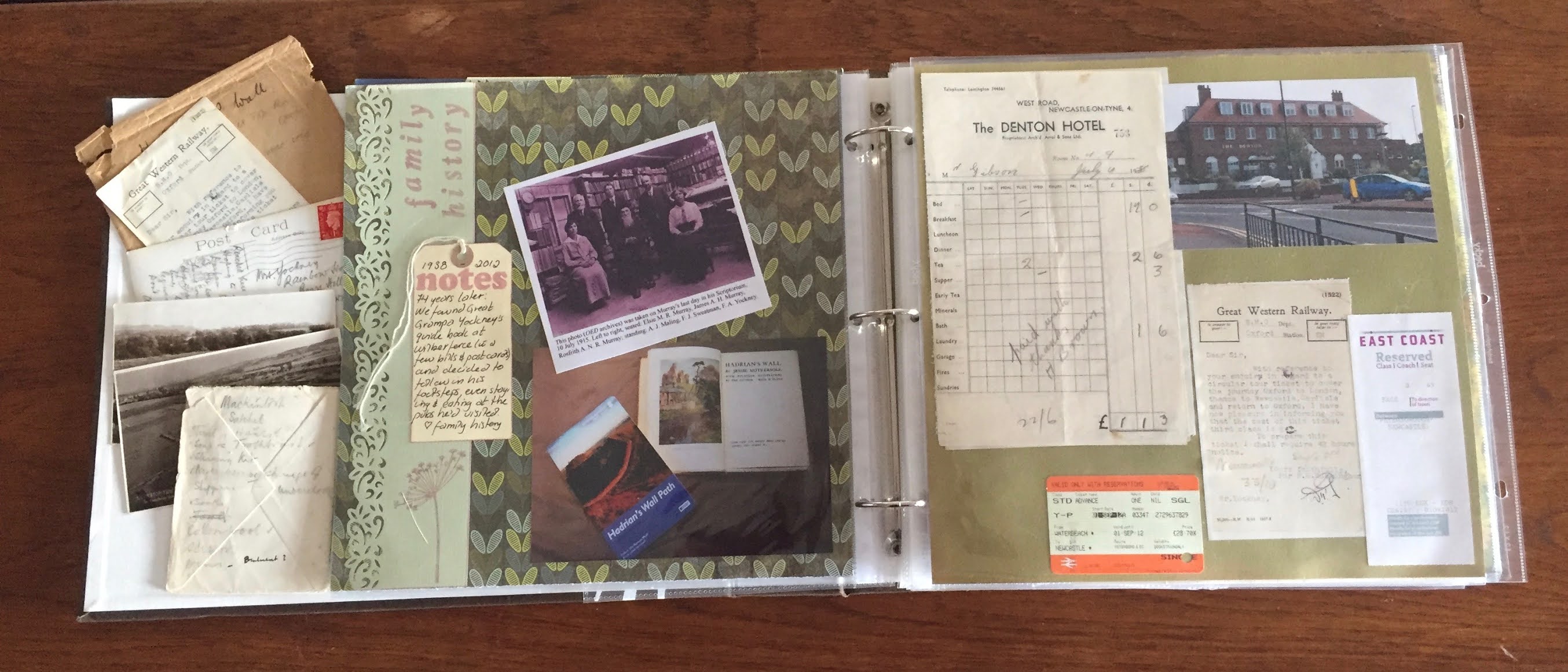
Doug and I celebrated our marriage by walking Hadrian’s Wall (as a coast-to-coast path) and the Speyside Way (distillery-to-distillery!) Fun fact: we found some bills, train tickets, and letters my great grandfather had saved (using them as bookmarks in his guidebook) from his exploration of Hadrian’s Wall in 1938, so we were able to retrace his steps.  We visited the same pubs he’d visited, and it became a running joke - translating old money into new and calculating the different in cost of a pint then and now. We also imagined and laughed about the differences and similarities in the food and the decor. So much joy from a handful of random bits of paper. 


(photo: scrapbook page from our Honeymoon, 2012)


Genetic predisposition or clutter . . . .  What matters to me is that I still find handwritten love notes from Doug tucked into books, and jacket pockets, and his desk drawers. I keep them on the fridge door, so that every single day I read his words. These tiny mementos of his love have become more precious to me than he ever could have imagined when he wrote them. 


Saturday, October 3, 2020

“Three Years Ago This Week”


(photograph: Harpers Ferry, autumn 2017)

I make photobooks with a service which occasionally sends me bittersweet email reminders of past albums. Today’s was from our tour of American Civil War battlefields. Can that really have been only three years ago? Doug was so well! He could still use a camera. He could shower, shave, and dress himself. When we sat with other couples at dinner I adopted a Bossy Wife persona and hoped people would assume he was quiet, rather than hear his struggles to converse. He had a few seizure-like episodes, but always in the mornings, before we met the rest of our group. He slept through movies and bus rides, but was alert when we reached each site.  


The majority of his book collection is non-fiction, with several shelves devoted to the American Civil War. He held on to that vast store of knowledge, and three years ago he could still access it. He’d previously visited some of the battlefields with his late Dad, and had happy memories of that holiday.  (So much so that one day we bought his Dad a souvenir. By then I had realised that it is kinder to pretend his parents are still alive than to keep retelling him the sad news of their deaths.)


This was the first time we booked an organised group tour, and I was hesitant. (It was not inexpensive.) I have no regrets, I’m so pleased we went. With hindsight, we had less time left to travel together than I had hoped. 


What I do regret are trips we didn’t take together, plays we didn’t see, things we didn’t do . . . things I didn’t do. I’m sorry I didn’t learn how to play Chess, I’m sad that we didn’t go out dancing together more often, I wish I’d resigned from my job sooner than I did. 


When I feel sorrow at something we left undone, I try to remind myself of all that we did do.  We never went to Dieppe, which was high on his bucket list, but we did go to Ypres, and the D-Day landing beaches. We walked many, many miles across England together. We rented a narrowboat with my Mum and step-Dad for a week. We vacationed in Mexico with my Mum, sister, nieces, and nephew.  We visited Scotland numerous times, including a Burns Night celebration in Burns’ birthplace. We packed picnics and went for day trips. We were regulars at our local pub’s weekly quiz night.  (And, I remind myself, through the first years of our marriage we were both working and I was earning a PhD; we made the most of our limited time and budget.) In Canada we’ve explored corners of Algonquin Park, walked all our local hiking trails, and travelled from Vancouver to Toronto by train. In our homes we baked, we played Scrabble, we listened to music, we spent hours silently sitting next to each other reading (history for Doug, fiction for me).


We made friends, we built a life - a good life - together, we have a language-for-just-us and code words and in-jokes. 


It’s a balancing act, but just thinking about all the cheerful memories I could list here shows me that my happy memories far outweigh my sad memories.  For me, this counts as a win.   


(photograph: Antietam, autumn 2017)